Showing posts with label Himalyan Glaciers. Show all posts

Thursday, September 2, 2010

US EPA Makes Cookstoves A Priority

Improved cook stoves
The US. Environmental Protection Agency (EPA) recently annouunced the international priorities of the the agency to include a focus on reducing black carbon through cookstoves. Among the six priorities outlined by the EPA Administrator Lisa P. Jackson was the priority on "Combating Climate Change by Limiting Pollutants."

The EPA says that while it has has taken important steps to reduce greenhouse gas emissions at home, but the global challenge of climate change requires a global solution. "To make significant progress in reducing the effects of climate change, pollution must be cut throughout the world. EPA will promote global strategies to reduce greenhouse gas emissions and other pollutants such as methane from landfills and black carbon from cookstoves. These pollutants are damaging especially vulnerable regions such as the Himalayan glaciers and the Arctic."

The announcement was made at a meeting of the Commission for Environmental Cooperation in Guanajuato, Mexico.

“Pollution doesn’t stop at international borders, and neither can our environmental and health protections. The local and national environmental issues of the past are now global challenges,” said EPA Administrator Lisa P. Jackson.

Read the full Press Release "Administrator Jackson Announces EPA’s International Priorities / Agency to work with other countries to curb pollution at home and abroad"

Image Description: Black Carbon and Sulfate Aerosol Optical Thickness. Image created by Science on a Sphere, Earth System Research Laboratory, NOAA. Image Location: NOAA http://sos.noaa.gov/images/atmosphere/black_and_sulfate.jpg .
Read More..

Friday, February 5, 2010

Black Carbon emissions from India up 51%

smoke-in-the-kitchenScientists from Lawrence Berkeley National Lab led by atmospheric scientist Surabhi Menon have taken a further step in making the linkage between black carbon or soot and glacier melting.

A Berkley Lab report says Previous studies have shown that black carbon can have a powerful effect on local atmospheric temperature. “Black carbon can be very strong,” Menon says. “A small amount of black carbon tends to be more potent than the same mass of sulfate or other aerosols.”

Menon and her collaborators found that airborne black carbon aerosols, or soot, from India is a major contributor to the decline in snow and ice cover on the glaciers.

“Our simulations showed greenhouse gases alone are not nearly enough to be responsible for the snow melt,” says Menon, a physicist and staff scientist in Berkeley Lab’s Environmental Energy Technologies Division. “Most of the change in snow and ice cover—about 90 percent—is from aerosols. Black carbon alone contributes at least 30 percent of this sum.”

Menon and her collaborators used two sets of aerosol inventories by Indian researchers to run their simulations; their results were published online in the journal Atmospheric Chemistry and Physics.

According to the report, Black carbon, which is caused by incomplete combustion, is especially prevalent in India and China; satellite images clearly show that its levels there have climbed dramatically in the last few decades. The main reason for the increase is the accelerated economic activity in India and China over the last 20 years; top sources of black carbon include shipping, vehicle emissions, coal burning and inefficient stoves.

According to Menon’s data, black carbon emitted in India increased by 46 percent from 1990 to 2000 and by another 51 percent from 2000 to 2010.

However, black carbon’s effect on snow is not linear. Menon’s simulations show that snow and ice cover over the Himalayas declined an average of about one percent from 1990 to 2000 due to aerosols that originated from India. Her study did not include particles that may have originated from China, also known to be a large source of black carbon.
Read More..

Tuesday, December 29, 2009

NASA Study says Black Carbon Deposits on Himalayan Ice Threaten Earth’s "Third Pole"

NASA Study says Black Carbon Deposits on Himalayan Ice Threaten Earth’s
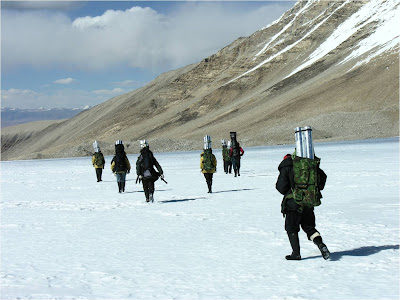
Black soot deposited on Tibetan glaciers has contributed significantly to the retreat of the world’s largest non-polar ice masses, according to new research by scientists from NASA and the Chinese Academy of Sciences. Soot absorbs incoming solar radiation and can speed glacial melting when deposited on snow in sufficient quantities. (Pic: To better understand the role that black soot has on glaciers, researchers trekked high into the Himalayas to collect ice cores that contain a record of soot deposition that spans back to the 1950s. Credit: Institute of Tibetan Plateau Research, Chinese Academy of Sciences)

Researchers led by Baiqing Xu of the Chinese Academy drilled and analyzed five ice cores from various locations across the Tibetan Plateau, looking for black carbon (a key component of soot) as well as organic carbon. The cores support the hypothesis that black soot amounts in the Himalayan glaciers correlate with black carbon emissions in Europe and South Asia.

Temperatures on the Tibetan Plateau -- sometimes called Earth's "third pole" -- have warmed by 0.3°C (0.5°F) per decade over the past 30 years, about twice the rate of observed global temperature increases. New field research and ongoing quantitative modeling suggests that soot's warming influence on Tibetan glaciers could rival that of greenhouse gases.

At Zuoqiupu glacier -- a bellwether site on the southern edge of the plateau and downwind from the Indian subcontinent -- black soot deposition increased by 30 percent between 1990 and 2003. The rise in soot levels at Zuoqiupu follows a dip that followed the enacting of clean air regulations in Europe in the 1970s.

Most soot in the region comes from diesel engines, coal-fired power plants, and outdoor cooking stoves. Many industrial processes produce both black carbon and organic carbon, but often in different proportions. Burning diesel fuel produces mainly black carbon, for example, while burning wood produces mainly organic carbon. Since black carbon is darker and absorbs more radiation, it’s thought to have a stronger warming effect than organic carbon.

"Tibet's glaciers are retreating at an alarming rate," said James Hansen, coauthor of the study and director of NASA’s Goddard Institute for Space Studies (GISS) in New York City. "Black soot is probably responsible for as much as half of the glacial melt, and greenhouse gases are responsible for the rest."

The study was published December 7th in the Proceedings of the National Academy of Sciences.

"Fifty percent of the glaciers were retreating from 1950 to 1980 in the Tibetan region; that rose to 95 percent in the early 21st century," said Tandong Yao, director of the Chinese Academy's Institute of Tibetan Plateau Research. Some glaciers are retreating so quickly that they could disappear by mid-century if current trends continue, the researchers suggest.

Since melt water from Tibetan glaciers replenishes many of Asia’s major rivers -- including the Indus, Ganges, Yellow, and Brahmaputra -- such losses could have a profound impact on the billion people who rely on the rivers for fresh water. While rain and snow would still help replenish Asian rivers in the absence of glaciers, the change could hamper efforts to manage seasonal water resources by altering when fresh water supplies are available in areas already prone to water shortages.
Read More..